June 14, 2012

The History of The American Quilt: Art Quilts

Welcome to Part Six of this seven part series brought to us by Molly Williams. Over the next seven weeks Molly will explore the people, politics, patterns and processes that informed the development of the American quilt. She will take us from early African-American quilts to the 21st Century Art quilts that we see today.

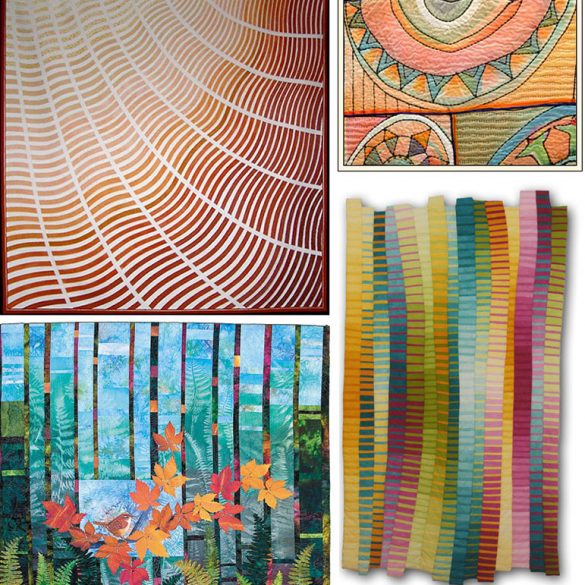
Although the traditional quilt was intended to function as a decorative bed cover, many of today’s quilts are intended for the gallery wall. Techniques and materials are frequently borrowed from other media such as painting, photography, and printmaking to bring greater self-expression and vibrancy to the work.

*images via: Nancy Crow, Color Blocks #22,1992, Nancy Crow Construction #83, Virginia Randles Helix 11, Anna Williams String Quilt Top

This shift began in the late 1960s when two art collectors, Jonathan Holstein and Gale van der Hoof, recognized that quilts could display abstract art much like the modern art that was in vogue at the time. They began to collect quilts that caught their eye and were able to convince the Whitney Museum in New York to do an exhibition, titled “Abstract Design in American Quilts.” The exhibit was a success and went on to travel around the United States and Europe.

The primary goal of an art quilt is not to keep people cozy, but to provoke an aesthetic or emotional response. Like paintings and sculptures in museums, art quilts are made to be looked at and responded to with the heart and mind.

* images via: ColorPlay II  – Anne Lullie, Laura Wasilowski, Judy Rush Expansion quilt

Using the quilter’s medium of layered fabric, art quilters combine traditional quilting techniques with concepts and techniques borrowed from graphic design and the fine arts. Contemporary art quilters use painting, printing, photography, collage, sculpture, jewelry-making, beading, and many other techniques to make quilts that speak to the viewer.

* images via: The Scallop by Dianne Firth– Sidney Quilt Show 2008, Marianne Burr – Portfolio 2, Anne R Parker Gradations, Cindy Vough

The styles and themes of today’s art quilts are as widely varied as the art being produced in other media. The essential element all art quilts share is fabric. Without fabric, they wouldn’t be quilts.

June 1, 2012

The History of The American Quilt: Recording Changes in Society

Welcome to Part Five of this seven part series brought to us by Molly Williams. Over the next seven weeks Molly will explore the people, politics, patterns and processes that informed the development of the American quilt. She will take us from early African-American quilts to the 21st Century Art quilts that we see today.

In the America, the 1960’s were revolutionary times. The civil rights and feminist movements were changing all facets of society, including the art and quilting worlds. A key leader in this movement was Faith Ringgold, an African-American artist renowned for her painted story quilts. Ringgold’s work reflects both her passion for the African American civil rights movement and her commitment to feminist issues. The colorful quilt seen below, top-left, depicts eight African American women freedom fighters: Madame C.J. Walker, Sojourner Truth, Ida B. Wells, Fannie Lou Hamer, Harriet Tubman, Rosa Parks , Mary McLeod Bethune, Ella Baker and Vincent van Gogh. Mother’s quilt, bottom-middle, was Ringgold’s first quilted painting, which combines paint with fabrics, a central painting bordered by the text of the story then an outer border of pieced fabrics.

images via: (Top-Left) Sunflowers Quilting Bee at Arles 1991, (Top-Right) Bitter nest: The home coming 1988, (Bottom-Right) Who’s afraid of Aunt Jemima, (Bottom-Middle) Mother’s quilt, (Bottom-Left) Tar beach 1990

Another movement in America centered around American Gay Rights. At the height of the movement AIDS struck the community, killing 60 Americans in 1980 and by 1985 AIDS deaths had risen to 3,000, with the number of cases doubling every 6 months. The ‘Names Project’ quilt started in 1987 when gay rights activist Cleve Jones made a quilt in memory of his best friend.  The quilt is made of thousands of individual memory quilts each measuring three feet by six feet – the size of a grave. On October 11, 1987, the quilt was displayed on the National Mall in Washington, D.C. – It covered a space larger than a football field and included 1,920 panels. Today the quilt weighs 54 tons and is composed of more than 47,000 panels

*images via: Aids quilt 1, Aids quilt 2, Aids quilt 3, The Names Project quilt

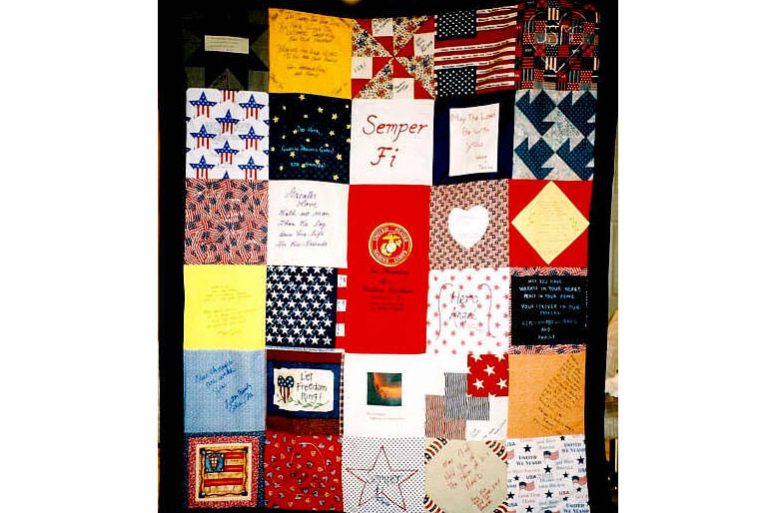
Quilts continue to be used to record historical moments and comfort those faced with immense challenges in American society. Currently, there are three groups making memorial quilts for fallen military personnel in Iraq and Afghanistan. One is the Marine Comfort Quilt Project. On March 23 2003, Jan Lang and her husband were given the news that their son, serving with the 1st Battalion 2nd Marines Charlie Company, was missing in action in Iraq. Twenty four hours later they learned that he had survived the attack but that 18 of his fellow Marines had not. Hugely elated and wondering why they had been so fortunate, Jan sought a way to reach out to the bereaved families. She decided to make a comfort quilt for each of family and the project has grown to encompass all the US military services active in the Middle East. ‘Each quilt is made of 12.5 x 12.5- inch blocks with a message written on each square. Each square delivers a message of love and comfort to those families so they know that their soldier is not forgotten’.

To join the group and donate a quilt square or materials, please visit the website: http://www.marinecomfortquilts.us/

* image via: Marine Comfort Quilts, Lance corporal Thomas A. Blair

May 17, 2012

The History of The American Quilt: Amish Quilts

Welcome to Part Four of this seven part series brought to us by Molly Williams. Over the next seven weeks Molly will explore the people, politics, patterns and processes that informed the development of the American quilt. She will take us from early African-American quilts to the 21st Century Art quilts that we see today. I find the history of textiles inspiring and fascinating and I hope you enjoy this series.

Amish Quilts

The Amish came to America in the mid 18th century and settled in Lancaster County, Pennsylvania. As the country opened up, they began to move to the Midwest, where they lived their lives according to the Bible and were the tillers of the soil, living close to the earth in a simple, ordered way.

Amish quilts are known for their solid colors and clear geometric designs. The stark colors resound off each other and the intricate loops and swirls of the quilting design mirror the contradiction between the severity of the Amish life and the rolling contours of the natural world, in which the Amish work year in year out.

These quilts were status symbols and ceremonial textiles to mark life stages: birth, marriage, death and each one was signed by its maker. A woman could expect to be judged, however discreetly, by the quality of her quilt. The traditional Lancaster quilts have a central medallion design and sombre colors were preferred.

* images via: Amish Farm August 1969, in the collection of Kathy Hogarth Charles, Old order Amish centre square quilt, Amish quilt, Lancaster county, Amish Diamond in the Square c.1915 Lancaster

As Amish communities migrated to the Midwest some women began to use brighter fabrics and developed more intricate patterns. Small, fine, evenly spaced stitches are the hallmark of any Amish quilt; the most experienced Amish quilter can stitch eight to ten stitches per inch in her quilting.

* images via: Amish Wool 16 Patch Quiltc.1928,Amish Pineapple Log Cabin c.1890-1910, Pinwheel quilt, 1930, Sunshine and shadow quilt, ca. 1940 Amish, Lancaster County, Broken Star 1920–30 Ohio, Amish Trip Around the World with Hunter Green Border c.1945 Lancaster, Pennsylvania

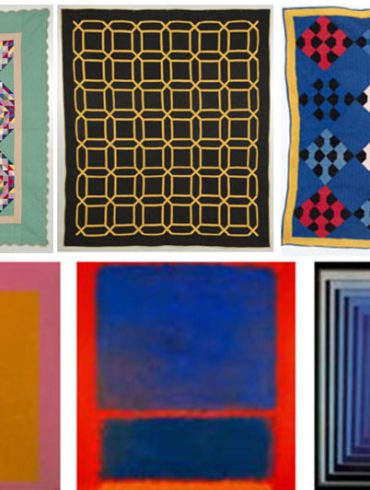
There are recognisable differences between Amish quilts. Quilts from the Midwest are made in block formation with more white and light green pieces, while Pennsylvania quilts are known for their large, bold designs and elaborate quilting.

Despite their traditional design Amish quilts remain fresh and surprisingly contemporary when compared to modern art. —- Molly

* images via: Cotton Waves 1930 Indiana, Honey comb 1920 Ohio, Amish Bowtie c.1940 New Wilmington, Pennsylvania, Victor Vaserely Amish centre square quilt 1930, Mark Rothko & Joseph Albers

May 10, 2012

The History of The American Quilt: 19th Century

Welcome to Part Three of the seven part series brought to us by Molly Williams. Over the next seven weeks Molly will explore the people, politics, patterns and processes that informed the development of the American quilt. She will take us from early African-American quilts to the 21st Century Art quilts that we see today. I find the history of textiles inspiring and fascinating and I hope you enjoy this series.

19th century quilts

Four distinct types of quilts developed during 19th century America: the American Pieced Quilt, 9 patch quilt, Album Quilt and the Victorian Crazy Quilt. The American Pieced Quilt, which was designed to accentuate the contrast between colors and patterns, began with a central medallion that spread out evenly over the quilt.

* images via: Postage Stamp Center Medallion Quilt Dated 1888, Silk Stars by Mary Mern. 1845. Hand pieced and quilted

The 9 patch quilt
It was the change in construction, from pieced medallions to nine-patch blocks that revolutionised American quilting. While bed-size quilts required a lot of room to piece, pieced patterns could be assembled in a relatively small space and easily carried until stitched together.

The Oregon Trail opened up the American West, where settlers carved out a life for themselves in the harsh wilderness. Quilts were made on the wagon and in the dugout and things of beauty were created from scraps of old clothing and feed sacks. Patterns, such as windmill blades, barn raising, straight furrow and court house steps, developed from the landscape.

* images via: www.oldquiltcompany.com, Windmill Quilt from Ben Mildwoff Collection, Straight Furrow Log Cabin Quilt
c. 1870, Barn Raising Log Cabin quilt

Album quilts
For more formal occasions, such as weddings and christenings, elaborately appliquéd Album Quilts were made to commemorate the special day. The detailed appliquéd tops were further embellished with intricate stitching as seen in the close-up image of this patriotic eagle and floral quilt.

*images via: Eagles with Floral Wreath Applique Quilt 
c.1875, Album quilt. Made by a member of the Hargest Family, Baltimore, Maryland Dated 1845

The Victorian Crazy Quilt

The Victorian Crazy Quilt was very different with its flamboyant pattern of rich silks and velvets embroidered together to make a contemporary display. It was a passion that began towards the end of the 19th century in response to the influence of Arts and Crafts movement and American Aesthetic Movement… change was in the air. – Molly

* image via: Victorian Crazy Quilt c 1890


May 3, 2012

The History of The American Quilt: 17th and 18th Century

Hello there! I am thrilled to announce Part Two of the seven part series on the history of the American quilt brought to us by Molly Williams. Over the next seven weeks Molly will explore the people, politics, patterns and processes that informed the development of the American quilt. She will take us from early African-American quilts to the 21st Century Art quilts that we see today. I find the history of textiles inspiring and fascinating and I hope you enjoy this series.

17th and 18th Century Whole Cloth Quilts

It is widely thought that the American tradition of patchwork began with the early settlers utilising every scrap of imported fabric to make warm quilts for the homestead. However research suggests that expensive, imported English whole cloth quilts were found in early colonial homes. The making of American whole-cloth quilts did not become established until the 1750’s and it was not until after the The Revolutionary War, when America was freed from trade restrictions imposed by the English, that quilting evolved with a unique American style – bolder colors and innovative designs.

*images (clockwise): “Copper plated printed whole-cloth quilt 1785,” “Cornish trapunto quilt early 17th Century,” “Whole Cloth Quilt,” “Trapunto Close up,” “Whole Cloth Quilt,”

A whole cloth quilt is not made from a single piece of fabric, as the name suggests; it simply means that the quilt is made from fabric of a single color or intricately embroidered to produce a highly textured, tactile design. In addition to embroidery, Trapunto or ‘stuffed technique,’ was used to add extra texture and dimension to whole cloth quilts.


17th and 18th Century Indian Chintz

* images (clockwise): “Broderie Perse Closeup,” “Winthur Collection,” “Chintz,” “17th and 18th C Indian Chintz, ” “Broderie Perse

By the beginning of the 18th century, Broderie Perse, French for “Persian Embroidery”, was a popular method of applique created from patterned chintz imported from India. The clearly defined floral motifs were cut out and appliqued onto plain cloth backgrounds, resulting in stunningly beautiful pieces. These quilts were luxurious, expensive and used for display on special occasions.

*images (Clockwise): “Broderie Perse Quilt,” Broderie Perse Fragments

In the 19th century, The Industrial Revolution brought about two key innovations which helped to popularize American quilting. Firstly, mechanised looms emerged, resulting in cheaper American fabrics and yarns. Secondly, the invention of the sewing machine accelerated the process of stitching small pieces of fabric together, making it quicker and easier to piece and produce quilts.

See you next week for Part 3 – 19th Century Quilts! – Molly

April 26, 2012

The History of The American Quilt: Part One

Hello there! I am thrilled to announce a seven part series on the history of the American quilt brought to us by Molly Williams. Over the next seven weeks Molly will explore the people, politics, patterns and processes that informed the development of the American quilt. She will take us from early African-American quilts to the 21st Century Art quilts that we see today. I find the history of textiles inspiring and fascinating and I hope you enjoy this series. Take it away Molly!

Early African American quilts

* images (clockwise): Starch-resist dyed Adire cloth, Kente cloth Ghana, Mali mud cloth, Fante Asafo flag Ghana (These war flags record historical events), Kuba cloth made from raffia – Zaire,

A key component of the history of the American quilt was the arrival of enslaved Africans to America. They brought the customs, signs and symbols of their culture, which included textiles and fabrics. African textiles have large asymmetric designs that ensure the pattern can be recognized from a distance and in the glare of sunlight; as well as sharply contrasting colors which enhance the visibility of both the cloth and the symbolic patterns. Asymmetrical deviations in the patterns are designed to confuse the path of evil spirits. In West Africa, strip weaving is the fabric construction process most used, where thin lines of fabric, which consist of symbols and patterns, are stitched together to make a wider cloth. Abstract, figurative and geometric designs portraying secret tribal symbols are incorporated into textiles, which can be seen in the Starch-resist dyed Adire cloth from Yorubaland, Nigeria.

In America, the traditional woven strips were substituted by fabric pieces and the subversive nature of African coded language continued. This enabled Africans to remember their roots and combined tribal histories, as seen in this piece by Harriet Powers. Although very few slave quilts have survived, two bible quilts made by Harriet Powers hang in the Smithsonian Institute. Powers was born into slavery in 1837, her appliqué quilts depict Christian biblical stories and may have been used as teaching tools; on the other hand, the crosses, stars and moons may represent the symbols of secret West African societies.

* image via: ‘Quilt’ by Harriet Powers 1886


The Underground Railroad Quilt

African American folklore records a system of quilts used to direct escaping slaves to freedom in Canada. Ozella McDaniel of Charleston, South Carolina, was taught the story of a system of quilts used to direct escaping slaves to freedom by her grandmother, a former slave. According to McDaniel, ten quilts where used to signal the journey plan. Different quilt patterns conveyed specific instructions for each stage of the journey.

#1) Monkey Wrench, Gather your belongings together #2) Log Cabin, A “safe” person to speak to #3) Bear’s Paw, Follow the bear tracks over the Appalachian Mountains #4) Shoofly, A friendly guide #5) Flying Geese, Points to the direction to follow #6) Drunkard’s Path, Travel in a zigzag path to avoid pursuers #7) Bow Ties, Dress in disguise #8) Star, Follow the North Star #9) Crossroads, Routes to Cleavland, Ohio (freedom)


Gees Bend quilts

*images via: The Quilts of Gees Bend

Despite their importance, there are very few early utility quilts left. Slaves, treated as possessions and commodities, were often sold on to other plantations; families were separated and belongings were shared or lost. Quilts, once irreparable, were recycled as the batting for new ones.

One small Alabama community, isolated since the civil war by the geography of the area, has retained a link with their African roots. The Gees Bend plantation was founded in 1814 by Joseph Gee. Although typical of many southern plantations, Gees Bend is remarkable in that after the Civil War of 1861 – 1865 it became an isolated backwater where generations of former Pettway slaves were left to develop their own style of quilts uninformed by the changes in the traditional American quilt.

Jessie Pettway’s ‘Bars and string-pieced columns’ 1929, illustrates the classic African aesthetics preserved within the Gees Bend quilt:

  • Asymmetric patterns and lines
  • Large bright blocks of color
  • A marked resemblance to the tradition of strip weaving

Seventy Gees Bend quilts were exhibited at The Whitney Museum, New York in 2002 and their popularity continues today. Check back next week for Part Two: 17th & 18th Century Traditional American Whole Cloth Quilts! – Molly

March 18, 2011

“Ladder of Success: The Power of Style in the Workplace”

Stephens College in Columbia, Missouri has an amazing costume collection. I visited their new facility a little over a year ago and was in vintage textile heaven. I cannot wait to go back, but in the meantime they are nice enough to post some pieces from their collection online. The pieces that you see above are from their latest exhibit, “Ladder of Success: The Power of Style in the Workplace.”

In celebration of Women’s History Month, the exhibit follows women’s fashions in the workplace from the 1890s to 1990s. “It shows how the rise of women in the workplace and the fashion that accompanied their success worked in tandem toward attaining a powerful presence there. The show’s theme originated from a 1940s dress (pictured top, left) made from a print of colorful ladders.”

This is such a fantastic idea for an exhibit and I love that the theme originated from a print!

February 28, 2011

Antiques

* Victorian shell art. Amazing, right?

* I love everything about those gold tin cans. On the right is this amazing 1920′s lace dress…kind of thinking I should go back and buy it..

My friend Lindsay and I went to the most amazing antique store (mall?) in Portland over the weekend. I was in HEAVEN! It is called Monticello Antiques and I highly recommend adding it to your Portland shopping list. I am a horrible photographer (working on that), but these are some of my favorite finds from the day. I hope everyone had a great weekend!

February 4, 2011

vera neumann pillows

Kristin Mernitz needs your help. She has an addiction to Vera Neumann and it may be affecting her marriage. To overcome this addiction she is selling these beautiful pillows made from her collection of Vera scarves and napkins. Her collection is BEAUTIFUL!!!!! So check out her etsy store and help a girl out!

January 27, 2011

capricious traveler

Capricious traveler is a gorgeous etsy store that sells vintage clothing and accessories. The pieces are well curated, super affordable, and beautifully photographed, which always adds to the shopping experience. These are some of my favorites. Pssst… the traveler also has a great blog!

December 7, 2010

DISCOVERY

I discovered this stunner of a dress at SwaneeGRACE‘s etsy shop. I love the motifs and colors, but what struck me was the hem of the dress. The print is placed in such a way that it almost looks ombred or dip-dyed. Love!

November 23, 2010

THE FEVER

Diaghilev and the Golden Age of the Ballets Russes, V&A

Diaghilev and the Golden Age of the Ballets Russes, V&A

Diaghilev and the Golden Age of the Ballets Russe, V&A

As a designer, it is really important to pay attention to what is going on culturally and to look for inspiration in our surroundings. Before becoming a textile designer I was a ballerina and often look to ballet for print and trim inspiration. The costumes, the textiles, the music, and the drive to perfection are all part of what make this art form so magical. Currently, the V&A Museum has an exhibit entitled, “Diaghilev and the Golden Age of the Ballets Russes.” The exhibit features over “300 objects including giant theatre cloths, original costumes, set designs, props and posters by artists and designers,” who were under the direction of artistic director Serge Diaghilev. If you can’t make it to the show, the V&A website has some amazing photographs and information for you to do your own research.

And then….to my absolute delight I stumbled across Black Swan, a psychological thriller which follows the competitive world of ballet. The trailer looks awesome and has a rockin’ female cast featuring Natalie Portman, Mila Kunis, and Winona Ryder. Black Swan comes out December 3rd and I can’t wait to see if it lives up to the world it imitates.

Black Swan, Fox Searchlight

Black Swan, Fox Searchlight

Black Swan, Fox Searchlight

November 1, 2010

MONDAY WITH MAD MEN

*images via amc

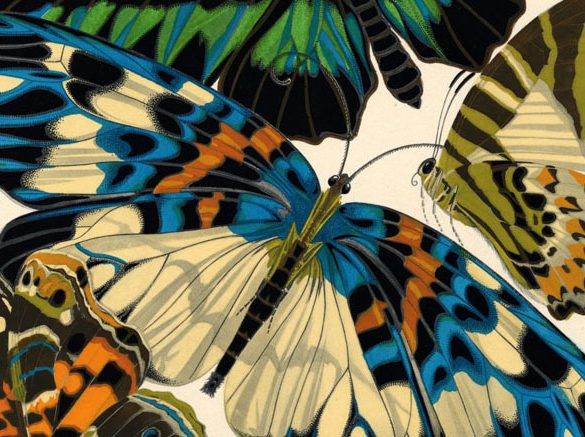
Like many of you out there, I just adore Mad Men. The show has great characters, story lines, and the wardrobes are always stunning. I know many of you are working on your Spring collections and I thought these images might provide you with a little dose of inspiration. I love the colors in the olive green dress seen above, and isn’t that engineered butterfly print pure genius? There is an entire blog devoted to the fashion sense of the show, which can be found here. Have a great Monday!

October 18, 2010

Vintage Buttons

I am working on an additional post for today..but in the meantime enjoy these fabulous buttons from the 1950′s. They, along with other wonderful finds, can be found at Haberflashery’s etsy site.

October 13, 2010

Vintage Fabric Finds

Vintage Yukata Cotton & Vintage Kimono Wool

*from banglezBeadz on etsy

*from AntiquesGaloreGal on etsy

October 9, 2010

VINTAGE FABRIC FIND

Cool vintage fabric inspiration for sale at whimsiedots.

Related Posts Plugin for WordPress, Blogger...