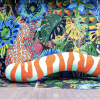
*images via: “Purple Urchins” by Steve Jurvetson, “Leafy Seadragon” by David Abercrombie, “Starfish” by Elias Levy, by Chelsea Densmore, “Graeff’s Sea Cucumber” by jayhem, “Jellyfish” by Joe Kelly, “Vibrant starfish” by Dave Townsend, “Jellyfish” by Shayne Kaye
April 30, 2012
Found Patterns: Sea Creatures
April 27, 2012
Feature Designer: Anvita Jain
Happy Friday! Last night’s webinar was an absolute blast and a big thank you to all who attended and asked such wonderful questions!
Today’s featured designer is Anvita Jain. I fell in love with Anita’s collage work. Collage is one of those mediums that looks like it would be very easy, but is so tricky! Combining the right textures, patterns and colors is truly an art form. Anvita is a graphic artist / illustrator currently finishing her MFA at Cranbrook Academy of Art. She works in a variety of mediums ranging from collage, drawing, digital, textiles, sculpture and installation. She loves working on projects where her work can be applied to a number of different applications and products. This collage is part of the identity Anvita designed for an indian fashion label called Studio Petticoat specializing in contemporary traditional clothing. The identity and collage are composed of elements that inspire the designers of the label. The collage was then applied to their business stationary, preview invites, tags etc. To check out more of Anvita’s work, please visit her website. Have a fantastic weekend!
April 26, 2012
The History of The American Quilt: Part One
Hello there! I am thrilled to announce a seven part series on the history of the American quilt brought to us by Molly Williams. Over the next seven weeks Molly will explore the people, politics, patterns and processes that informed the development of the American quilt. She will take us from early African-American quilts to the 21st Century Art quilts that we see today. I find the history of textiles inspiring and fascinating and I hope you enjoy this series. Take it away Molly!
Early African American quilts
* images (clockwise): Starch-resist dyed Adire cloth, Kente cloth Ghana, Mali mud cloth, Fante Asafo flag Ghana (These war flags record historical events), Kuba cloth made from raffia – Zaire,
A key component of the history of the American quilt was the arrival of enslaved Africans to America. They brought the customs, signs and symbols of their culture, which included textiles and fabrics. African textiles have large asymmetric designs that ensure the pattern can be recognized from a distance and in the glare of sunlight; as well as sharply contrasting colors which enhance the visibility of both the cloth and the symbolic patterns. Asymmetrical deviations in the patterns are designed to confuse the path of evil spirits. In West Africa, strip weaving is the fabric construction process most used, where thin lines of fabric, which consist of symbols and patterns, are stitched together to make a wider cloth. Abstract, figurative and geometric designs portraying secret tribal symbols are incorporated into textiles, which can be seen in the Starch-resist dyed Adire cloth from Yorubaland, Nigeria.
In America, the traditional woven strips were substituted by fabric pieces and the subversive nature of African coded language continued. This enabled Africans to remember their roots and combined tribal histories, as seen in this piece by Harriet Powers. Although very few slave quilts have survived, two bible quilts made by Harriet Powers hang in the Smithsonian Institute. Powers was born into slavery in 1837, her appliqué quilts depict Christian biblical stories and may have been used as teaching tools; on the other hand, the crosses, stars and moons may represent the symbols of secret West African societies.
* image via: ‘Quilt’ by Harriet Powers 1886
The Underground Railroad Quilt
African American folklore records a system of quilts used to direct escaping slaves to freedom in Canada. Ozella McDaniel of Charleston, South Carolina, was taught the story of a system of quilts used to direct escaping slaves to freedom by her grandmother, a former slave. According to McDaniel, ten quilts where used to signal the journey plan. Different quilt patterns conveyed specific instructions for each stage of the journey.
#1) Monkey Wrench, Gather your belongings together #2) Log Cabin, A “safe” person to speak to #3) Bear’s Paw, Follow the bear tracks over the Appalachian Mountains #4) Shoofly, A friendly guide #5) Flying Geese, Points to the direction to follow #6) Drunkard’s Path, Travel in a zigzag path to avoid pursuers #7) Bow Ties, Dress in disguise #8) Star, Follow the North Star #9) Crossroads, Routes to Cleavland, Ohio (freedom)
*images via: The Quilts of Gees Bend
Despite their importance, there are very few early utility quilts left. Slaves, treated as possessions and commodities, were often sold on to other plantations; families were separated and belongings were shared or lost. Quilts, once irreparable, were recycled as the batting for new ones.
One small Alabama community, isolated since the civil war by the geography of the area, has retained a link with their African roots. The Gees Bend plantation was founded in 1814 by Joseph Gee. Although typical of many southern plantations, Gees Bend is remarkable in that after the Civil War of 1861 – 1865 it became an isolated backwater where generations of former Pettway slaves were left to develop their own style of quilts uninformed by the changes in the traditional American quilt.
Jessie Pettway’s ‘Bars and string-pieced columns’ 1929, illustrates the classic African aesthetics preserved within the Gees Bend quilt:
- Asymmetric patterns and lines
- Large bright blocks of color
- A marked resemblance to the tradition of strip weaving
Seventy Gees Bend quilts were exhibited at The Whitney Museum, New York in 2002 and their popularity continues today. Check back next week for Part Two: 17th & 18th Century Traditional American Whole Cloth Quilts! – Molly
April 25, 2012
Street Patterns: Hello Sailor!
* post by Victoria Snape, images via: (Top-Left) Bouy 6, (2nd Row Right) Me make, (3rd Row Left) Flossy and Dossy, (3rd Row Right) Teja Jamilla, (Bottom-Middle) On your case
April 24, 2012
Less Is More at Lyn Devon Fall ’12
* images via style.com
I love the effortless lady-like styling in this collection from Lyn Devon. Simplistic, but beautiful prints and wovens perfectly accent the sleek garments. This collection is a reminder that sometimes less is more. As a print designer, I am always drawn to the splashy print collections with bold colors and of course, print and pattern mixing. But I have to ask myself, how many customers actually want to wear/buy these looks? The challenge of bringing trends and prints to the masses is what excites and humbles me on a daily basis. Things may fly on the runway, but the street is a much tougher critic. What design challenges do you enjoy?
April 23, 2012
Found Patterns: Utah Canyons
*images via: “Shillelagh Gold” by Jason Hollinger, “Cottonwood Narrows North 4908″ by Ed Siasoco, “Bryce Canyon5″ by Birgit Juel Martinsen, “Peek-a-Boo Gulch” by Jason Hollinger, “Wavy Rocks” by Jason Hollinger, “Escalante” by Colin Mutchler, “Taylor Canyon” by John Holm, “Cottonwood Narrows” by Ed Siasoco
April 18, 2012
Street Patterns: Tropical Prints
*post by Victoria Snape, images via: (Top Left) Oh My Honey!, (Top Right) TiCCi Rockabilly, (Bottom Right) MirthQuake, (Middle Left) Cat Taylor Design
April 17, 2012
Jean-Charles de Castelbajac Fall ’12
*images via style.com
Hello there fellow Pattern Observers! I am diggin’ this Fall collection from Jean-Charles de Castelbajac, which was inspired by the rugged landscape of Iceland. The collection is a beautiful example of engineered prints done right. From the mock-border print dresses to the winged capes and chevron sweaters, the designer thought through the usage of each and every graphic placement. When I see collections such as this one, I always wonder which came first the graphic or the garment?
When I am stuck in a creative rut, I find that thinking about the final product brings on a slew of new ideas. There is something about envisioning how the print will be used, whether it be on a garment or in the consumer’s home, that brings about the most compelling ideas.
—Michelle
April 16, 2012
Found Patterns: Berries
*images via: “Accumulated sunshine” by Jens Rost, “Red berries” by Mike G, “Blueberry” by Will Merydith, “Direction.” by Ben Seidelman, “Berries on a Vine” by Eric Kilby, “Cranberries” by Liz West,“Blueberry Amoeba” by Michael Bentley
April 13, 2012
Feature Designer: Jennifer Robinson
I am thrilled to share these beautiful pieces from designer Jennifer Robinson, which were created using silk screen printing, digital printing, embroidery and embellishment. Jennifer is graduating in June from the Cleveland College of Art and Design and is seeking employment! To see more work please visit her blog.
Have a great weekend!!! -Michelle